Source Portable Airtight Medicine Box for Car, Home, Travel
Compare 30 portable airtight medicine box options from verified suppliers. These modern, foldable storage solutions in ABS or PP plastic are ideal for organizing medicine, jewelry, and small essentials in cars, living rooms, or while traveling.
Key considerations
Products List







Comprehensive Sourcing Guide
Strategic Sourcing Guide for Portable Airtight Medicine Boxes
The global demand for portable airtight medicine boxes has surged as consumers and healthcare providers prioritize medication organization, safety, and portability. For B2B buyers, sourcing these items requires a disciplined approach that balances technical specifications, material integrity, and supply chain reliability. The market offers a diverse range of products, from simple single-compartment containers to complex, foldable multi-tier systems. This guide provides a structured framework for evaluating potential suppliers and products, ensuring that procurement decisions are grounded in verifiable data and industry best practices rather than marketing claims.
Technical Specifications and Material Integrity
When evaluating portable airtight medicine boxes, the primary technical differentiator is the material composition and the manufacturing process. The most common materials observed in high-quality units are Acrylonitrile Butadiene Styrene (ABS) and Polypropylene (PP). ABS is frequently cited for its rigidity and impact resistance, making it suitable for travel scenarios where the box might be dropped or subjected to pressure. Conversely, PP offers excellent chemical resistance and flexibility, which is advantageous for sealing mechanisms and repeated opening and closing cycles.
Buyers must scrutinize the dimensional specifications provided by suppliers. Standard dimensions for compact, portable units often hover around 9.8cm in length, 6cm in width, and 2cm in height, designed to fit easily into carry-on luggage or pockets. However, larger storage solutions may vary significantly, with dimensions extending to 30cm or more depending on the intended capacity. Tolerance levels are critical; a dimensional tolerance of 1.0mm is a standard benchmark for injection-molded plastic components. Deviations beyond this range can compromise the airtight seal, leading to moisture ingress and medication degradation.
The manufacturing technique, specifically injection molding, is the industry standard for producing these boxes. This process ensures high precision and consistency in the production of complex features such as folding hinges and locking latches. The weight of the product is another key specification. For smaller units, weights may be as low as 60g, while larger, multi-compartment versions can weigh up to 740g. Buyers should verify that the weight specifications align with the stated dimensions to ensure the product is not under-engineered or over-packaged.
Functional Design and Application Scenarios
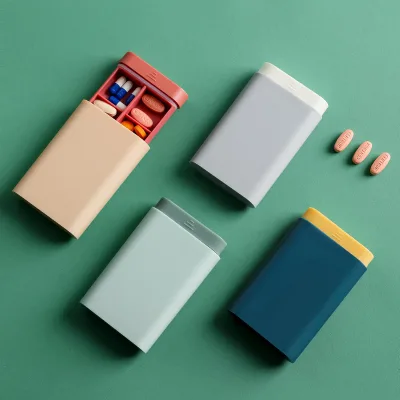
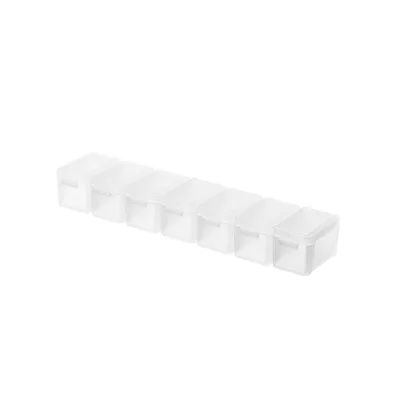
The utility of a portable airtight medicine box extends beyond simple storage; it encompasses a range of functional designs tailored to specific user needs. A notable feature in modern designs is the foldable capability, which allows the box to expand for storage and collapse for transport. This "Modern Simplicity" style is highly valued in the consumer market for its space-saving attributes. The shape is predominantly rectangular, providing efficient use of internal volume and stacking capabilities.
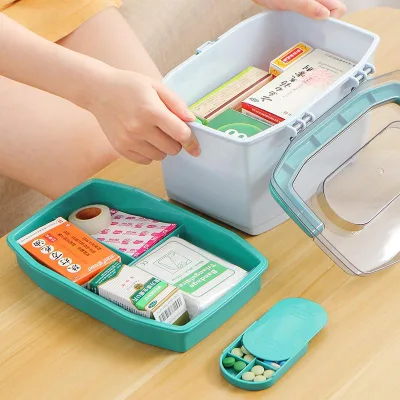
The scope of application for these products is broad. While the primary use case is the storage of medicine and pills, the design often supports secondary applications such as jewelry, earrings, and small accessories. The storage scenarios identified in the market include cars, living rooms, bedrooms, outdoor activities, and carry-on luggage. This versatility suggests that a successful product line must cater to both domestic organization and on-the-go medical management.
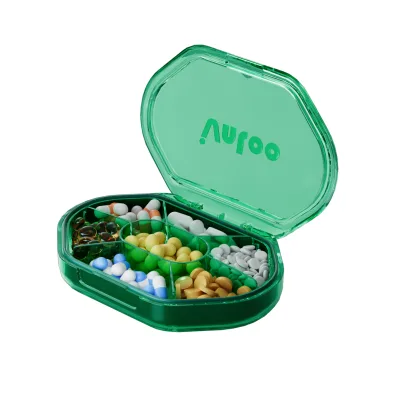
Color options play a significant role in product selection, with common offerings including green, blue, pink, and gray. These colors are often selected to differentiate product lines or to appeal to specific demographic segments. Additionally, the printing capabilities, such as single-page printing, allow for branding or instructional labeling, which is essential for B2B clients looking to customize products for their own brands.
Compliance, Certification, and Quality Standards
In the realm of medical storage, compliance and quality assurance are paramount. While specific certification statuses vary by supplier and region, buyers must verify that the materials used are food-grade or pharmaceutical-grade safe. The product category is explicitly defined as a "Sealed Pill Box," which implies a need for high standards regarding moisture and air exclusion.
Suppliers often reference specific standards for their products, such as dimensional standards for packaging or custom size requirements. For instance, some products adhere to standards like 12.8cm by 16cm by 4.2cm for specific packaging configurations. Buyers should request documentation proving that the plastic materials (ABS or PP) meet relevant safety standards for contact with pharmaceuticals.
Quality control metrics should also include weight tolerance, with a common industry benchmark being less than ±1%. This ensures that every unit produced falls within a predictable weight range, which is crucial for automated packaging lines and shipping cost calculations. Furthermore, the "prod_standard" often dictates the carton size and quantity, such as S, M, and L sizes with corresponding carton dimensions like 25cm by 20.5cm by 17.5cm. Verifying these logistical standards is essential for supply chain efficiency.
Cost Drivers and Pricing Dynamics
The pricing of portable airtight medicine boxes is influenced by several factors, including material costs, manufacturing complexity, and customization requirements. The observed price range in the market spans from $0.05 to $107 per unit, reflecting the vast difference between basic, single-item units and premium, highly customized, or large-capacity sets.
The Minimum Order Quantity (MOQ) is a significant cost driver, ranging from 1 unit for sampling to 5,000 units for bulk production. Higher MOQs typically result in lower per-unit costs due to economies of scale in material purchasing and production setup. Customization options, such as OEM/ODM services, add to the cost but are often necessary for brands seeking unique market positioning. The sample turnaround time, typically 3-5 days per order sequence, also impacts the overall procurement timeline and cost structure.
Buyers should analyze the "Selling Units" and "Carton Qty" to understand the true cost per unit. For example, a product sold as a single item might have a higher unit price compared to a bulk carton containing 100 pieces. The packing method, whether in OPP bags or cartons, also affects the final price, as more robust packaging adds to the material and labor costs.
Supplier Evaluation and Verification
Selecting the right supplier requires a rigorous evaluation process. The place of origin for many of these products is Zhejiang, China, a region known for its robust manufacturing infrastructure in the plastics industry. However, the location alone does not guarantee quality. Buyers should verify the supplier's production capabilities, specifically their ability to handle injection molding and custom design requests.
Key evaluation criteria include the supplier's responsiveness to customization requests, their ability to provide samples within the stated turnaround time, and their track record for meeting quality standards. The availability of OEM/ODM services is a strong indicator of a supplier's flexibility and capacity to meet specific client needs. Additionally, buyers should assess the supplier's inventory management and ability to handle large order volumes without compromising on quality or lead times.
It is crucial to avoid relying solely on marketing claims. Instead, buyers should request detailed product specifications, material safety data sheets, and production process documentation. The "prod_model" numbers, such as EMY-YHPB2907 or skr-030, serve as unique identifiers that can be used to track specific product iterations and ensure consistency across orders.
Quality Control and Long-Term Procurement Considerations
Implementing a robust quality control (QC) protocol is essential for maintaining product integrity. QC checks should focus on the airtight seal, the durability of the folding mechanism, and the accuracy of dimensions. Visual inspections for defects such as flash, warping, or discoloration are standard practices. Functional testing, such as opening and closing the box multiple times to ensure the latch remains secure, is also recommended.
For long-term procurement, buyers should consider the scalability of the supplier. The ability to maintain consistent quality over large production runs is critical. Buyers should also evaluate the supplier's capacity for innovation, as the market for portable storage solutions is evolving with new materials and designs. The "Special Feature" of portability must be maintained even as the product line expands to include new sizes or colors.
Finally, buyers should establish clear communication channels with suppliers to address any issues promptly. The "prod_packing" specifications, such as OPP Bag/Carton or Carton-only, should be agreed upon in advance to prevent shipping damage. By focusing on these technical and operational details, buyers can secure a reliable supply of high-quality portable airtight medicine boxes that meet the demands of their end consumers.
Comparative Analysis of Product Attributes
To facilitate decision-making, the following table summarizes key attributes observed in the market for portable airtight medicine boxes. This comparison highlights the variations in specifications that buyers should consider when selecting a product.
| Attribute | Observation A (Compact) | Observation B (Standard) | Observation C (Large/Custom) |
|---|---|---|---|
| Material | ABS | PP | ABS/PP Hybrid |
| Dimensions | 9.862cm | 221614cm (S) | 30.522.522cm (L) |
| Weight | 60g | 342g (S) | 740g (L) |
| Feature | Foldable | Solid Color | Custom Size |
| Application | Medicine, Jewelry | Home, Office | Travel, Outdoor |
| Packing | OPP Bag | Carton (100 PCS) | Carton (1 PCS) |
| Origin | Zhejiang, China | China | China |
This table illustrates that while the core function remains consistent, the specific attributes vary significantly based on the intended use case and size. Buyers must align these attributes with their specific market requirements to ensure the selected product delivers the expected value.
Conclusion
Sourcing portable airtight medicine boxes requires a meticulous approach that prioritizes technical specifications, material quality, and supplier reliability. By understanding the nuances of ABS and PP materials, verifying dimensional tolerances, and evaluating the functional design features, buyers can make informed decisions that meet the needs of their customers. The market offers a wide range of options, from basic single-item units to complex, customizable solutions. Success in this sector depends on the ability to navigate the diverse landscape of specifications and to partner with suppliers who demonstrate a commitment to quality and innovation. Through rigorous evaluation and clear communication, B2B buyers can secure a steady supply of high-performance storage solutions that enhance the organization and safety of medication and other small items.
FAQs
What material is used for portable airtight medicine boxes?
These boxes are primarily made from ABS or PP plastic. ABS offers rigidity and impact resistance for travel, while PP provides chemical resistance and flexibility for sealing mechanisms in repeated use cycles.
Can the product be customized for specific branding needs?
Yes, customization is available for these sealed storage boxes. Buyers can request OEM or ODM services to alter dimensions, colors like green or blue, and apply single-page printing for branding purposes.
How fast can a sample order be produced?
A sample turnaround time is typically 3 to 5 days per order sequence. This allows buyers to verify quality and specifications before committing to larger bulk production runs with higher minimum order quantities.
What are the standard dimensions for compact units?
Standard compact dimensions are approximately 9.8 by 6 by 2 centimeters. These sizes are designed to fit easily into carry-on luggage or pockets while maintaining a rectangular shape for efficient stacking.
Which storage scenarios support these medicine boxes?
These boxes are suitable for cars, living rooms, bedrooms, outdoor activities, and carry-on luggage. Their foldable design and airtight seal make them versatile for both home organization and on-the-go medication management.
What is the weight tolerance for these plastic containers?
The weight tolerance is strictly maintained at less than plus or minus 1 percent. This precision ensures consistency for automated packaging lines and helps in accurate shipping cost calculations for bulk orders.